This shift was explicitly mentioned on 11 November 2025 during a closed-door member webinar organised by the Bio-based Industries Consortium (BIC). Dirk Carrez, Executive Director of BIC, formulated a clear message: ‘Dual use offers new opportunities for the further development of biomanufacturing.’
Rapidly changing context
According to Carrez, participation in dual-use projects is a strategic choice made by individual companies. At the same time, he believes it is necessary for the sector to become aware of the rapidly changing context in which industrial biotechnology and biomanufacturing operates: climate challenges, geopolitical tensions, dependence on energy and critical raw materials.

This reality is already visible in the United States. The US Department of Defense is actively investing in biomanufacturing through programmes such as the Distributed Bioindustrial Manufacturing Program (DBIMP). This involves a wide range of materials and products: from biobased polymers and chemicals to food and fuels. Public-private initiatives such as BioMADE focus explicitly on scaling up biobased production capacity with civil and military relevance.
Europe is now moving in the same direction, albeit with some delay and greater institutional caution. Carrez points out that NATO has set up specific innovation funds also looking to biomanufacturing in Europe. ‘So there are opportunities that our industry should take a closer look at.’ On the stock markets, the share prices of defence-related companies are now skyrocketing. The call to strengthen European defence capabilities is also leading banks and asset managers to take a more flexible stance towards investments in this industry.
Dual use as industrial logic
The BIC webinar showed that, in the case of biomanufacturing, dual use is also about reducing dependence in terms of materials, and ensuring the security of supply. Defence applications can have different requirements than civilian markets such as lower weight, higher durability, extreme conditions, and a longer service life. This applies to vehicles, textiles, energy supply and drones — precisely the sectors in which biobased materials are becoming increasingly relevant.

The key to this is bringing civil and defence applications together early in the innovation process: dual use by design. This creates economies of scale, faster learning curves and more robust business cases. Waiting until a product is “finished” and only then looking at defence applications leads to missed opportunities and additional costs.
According to Dominik Patzelt, a biologist and biotechnologist of the German company VCG.AI, this reasoning is closely in line with recent European policy documents. These documents state that the traditional separation between civil and military R&D is artificial and hinders innovation. During the webinar, Patzelt presented four hypothetical but realistic examples to illustrate the artificiality of this separation:
- Biobased polymers for vehicles
Biobased plastics can be used in non-critical vehicle components, both civil and military. An examples is polypropylene, used in interior finishings, door panels, dashboards, bumpers and protective covers. These components make up only a small part of the total vehicle (approximately 3%, according to Patzelt), but account for 20% of all plastics in those vehicles. According to him, the dual-use advantage lies in weight reduction, lower maintenance costs and more robust supply chains. Defence vehicles can function as a high-performance niche that can accelerate innovation. Europe already has the feedstock, technology and industrial players to enable scaling up. - Biobased carbon fibres for drones and lightweight structures
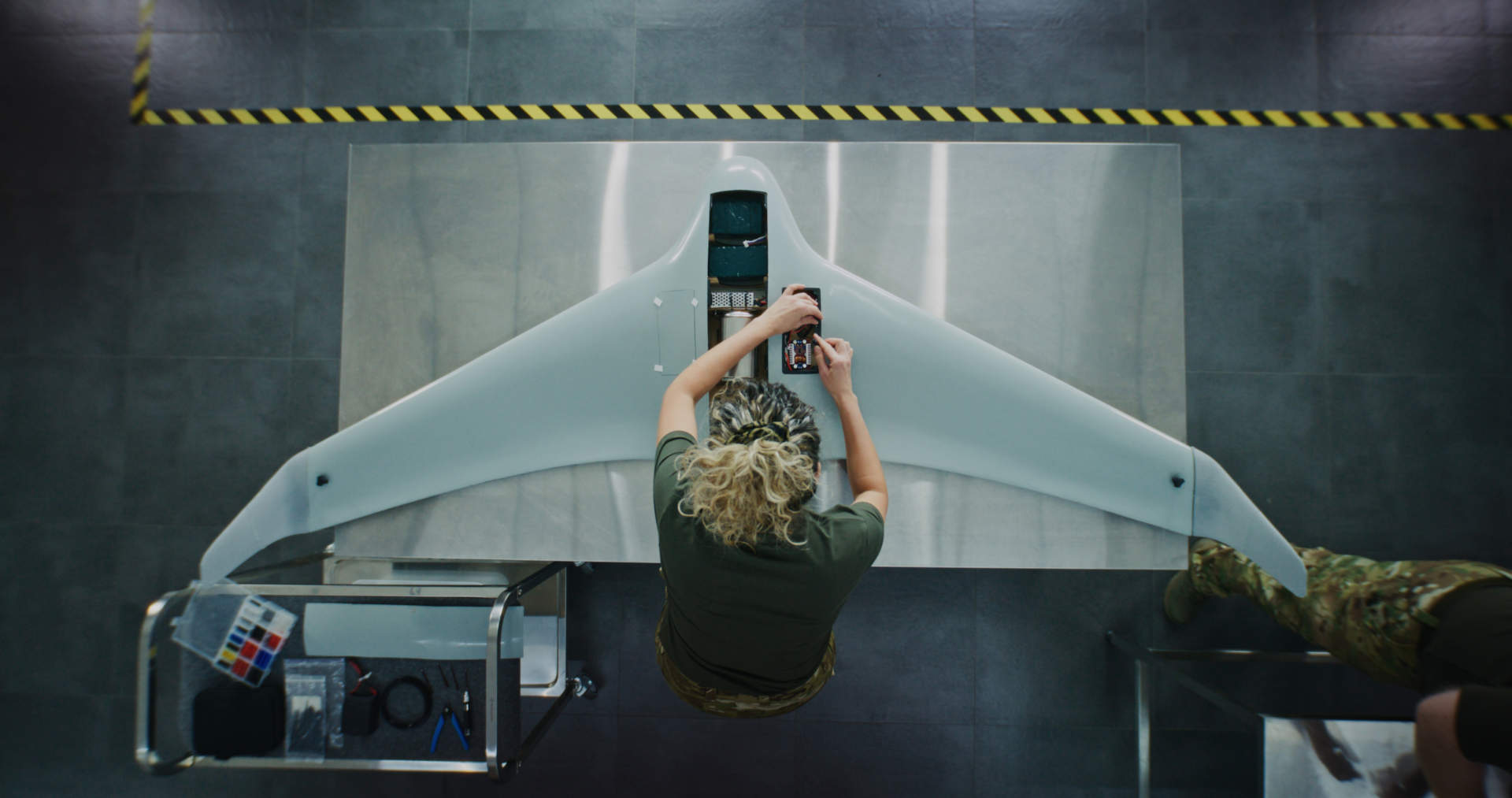
Carbon fibre is a strong and light material that is essential for drones and other lightweight platforms. According to Patzelt, up to 32 per cent of a drone can be made of carbon fibre. The dual-use advantage here lies mainly in better performance under harsh conditions: ‘Carbon fibre can improve the strength-to-weight ratio, increase resistance to harsh conditions and enhance the mobility and fuel efficiency of such systems.’ Biobased alternatives — including those made from lignin — already exist, but are often still at low TRLs. The combination of defence demand and civil aviation and mobility markets could be decisive for upscaling in this area. - Natural fibres for textiles and uniforms
Textiles for defence require durability, protection and functionality. Natural fibres such as hemp, wool or new biobased fibres can play a role here, with clear civil spin-offs for performance and workwear. ‘Natural fibres can potentially make up 90% of a complete uniform,’ says Patzelt. Their application in defence is not only about providing better protection against wear and tear and environmental influences, but also about the ‘reduced radar visibility of natural fibres in the field.’ - Lignin-based materials for energy storage
Lignin is a widely available but still little-used residual stream from woody fibres. It can be used for (marine) fuel or as a substitute for bitumen, but also for more high-value applications, such as a substitute for graphite in battery electrodes, which is important for both civil mobility and military deployability. ‘It allows us to reduce our dependence on rare earth elements and vulnerable supply chains. For defence applications, the use of lignin can lead to lighter or more robust energy systems and a lower environmental impact in mobile applications.’ The technological maturity of this technology varies greatly: from a very early experimental stage to commercial availability. Since 2021, the Finnish company Stora Enso is operating a pilot plant that demonstrates the scalability of producing battery electrodes from lignin.
The recurring theme in all these cases: ‘Europe has the raw materials, knowledge and industrial base for biomanufacturing in these markets, but often lacks the market pressure and investment certainty needed to scale up.’
Europe versus the US
The difference with the US is clearly visible. In America, defence openly acts as a launching customer for biobased innovation. Civilian markets provide volume; defence legitimises investments in capacity, speed and performance. There, dual use is already an economic and strategic reality.
Europe, on the other hand, still approaches dual use as something that must be justified, defined and regulated. Academic institutions are cautious, companies are careful, and regulations are complex. There is now a growing awareness that this caution poses a risk to European competitiveness and strategic autonomy. The BIC webinar explicitly positions industrial biotechnology and biomanufacturing in this area of tension: not as a defence industry, but as a critical enabling technology.
Market expansion
An important point that was repeatedly emphasised during the webinar is that dual use for biobased companies does not automatically mean that they will “start working for defence”. The main focus is on market expansion. Defence applications can set higher performance requirements and enable additional funding, after which civil applications benefit from scale, cost reduction and technological maturation.
The pattern has been seen before: composite materials, satellite navigation systems and various technologies in the aviation and medical sectors were initially developed in a military context and were subsequently adopted in civilian markets. Biobased materials can follow the same path — provided that Europe makes it institutionally possible.
Awareness as a first step
The BIC message to members and policymakers is primarily: do not forget industrial biotechnology and biomanufacturing in the dual-use debate. While attention often focuses on artificial intelligence, health and biosafety, materials, chemicals and biomanufacturing remain underexposed — even though Europe is particularly strong in these areas.
Patzelt summarised it as follows: Europe has the science, technology and markets to be a leader in dual-use materials. The question is not whether this will happen, but whether it will happen consciously, strategically and in time.
Resilience and autonomy
The rise of dual use in Europe marks a fundamental recalibration of industrial and innovation policy, broadening the market options. Industrial biotechnology and biomanufacturing are not only becoming a solution to climate and raw material issues, but also a pillar of economic resilience and strategic autonomy.
Europe is at the beginning of a race to catch up, certainly in comparison with the US. The BIC webinar shows that the sector can take up the gauntlet — provided that awareness is translated into policy, funding and concrete market demand.
This article was produced in collaboration with the Bio-based Industries Consortium.
Photo above: Abd Awwad/Shutterstock